
In the mass media, three dates for the discovery of the cave are encountered: 1959, 1969, 1977. This is due to the following.
In 1946, in the area of Criva village, in the north of the former Moldavian Soviet Socialist Republic (hereafter MSSR), following geological exploration, a gypsum deposit was discovered, which was close to the surface. In 1954, industrial extraction of gypsum began using the open-pit method. In 1959, after a routine explosion, a cavity opened in the quarry wall from which water gushed. At that time, only one of the upper galleries was affected, and not the system itself.
In the year 1969, scientists from the Academy of Sciences of the MSSR researched the cavities near the gypsum extraction quarry and published descriptions of the gypsum cavities and the nearby karst region.
The official date of the cave’s discovery, naming, and first mapping is 12.03.1977. These are due to the speleologist club from the “Troglodyt” student club in the city of Chernivtsi, located today in Ukraine, who after another routine explosion discovered in the quarry wall the entrance to the immense karst system; all other previously described cavities being only systems of a few dozen meters that are still found near the quarry. In just one month, the speleologists put on paper 10 km of the labyrinth and named the cave “Zolushka,” which in Romanian translation means Cinderella. The idea for the name was inspired by the similarity of the character’s features from the story – the hidden beauty, the more modest appearance of the speleothems, and the clay found almost everywhere in the cave (see the face dirty with ash in the story). In the year 1992, after the Republic of Moldova gained independence from the Soviet regime, the government decided to rename the cave in honor of the Romanian scientist, the father of biospeleology and great adventurer Emil Racoviță. Since then, the cave bears two names.
In parallel with the scientists from Ukraine, scientists from the Academy of Sciences of the MSSR worked in the cave. Each group carried out research, developed maps, and scientific publications separately.
Between the years 1978 and 1982, the length of the galleries increased from 20.3 km to 61.9 km. Starting with the year 1984, the ABIS speleologist club from the city of Chișinău, MSSR, joined the research and mapping of the cave.
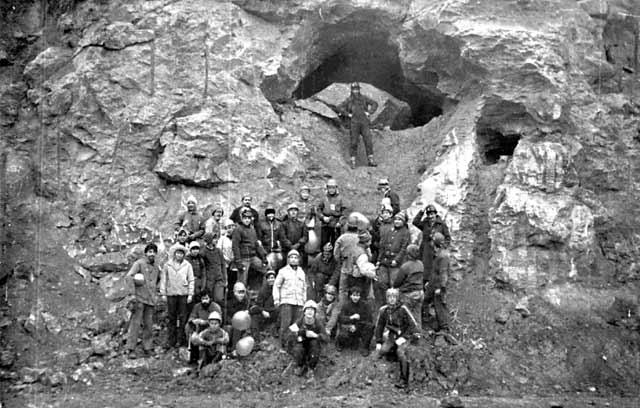
Cave entrance, 1986, author unknown.
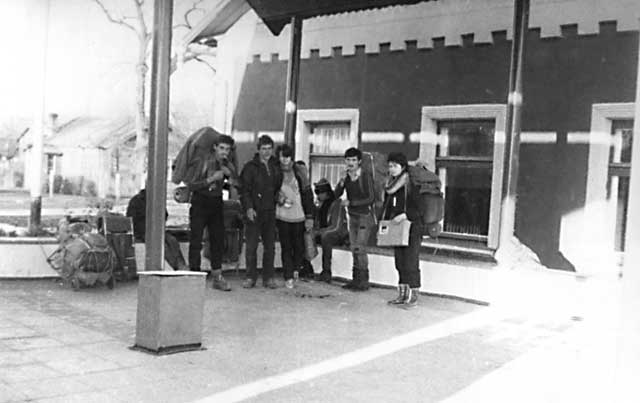
Members of the ABIS speleology club at the Mămăliga railway station, 1986, author unknown.
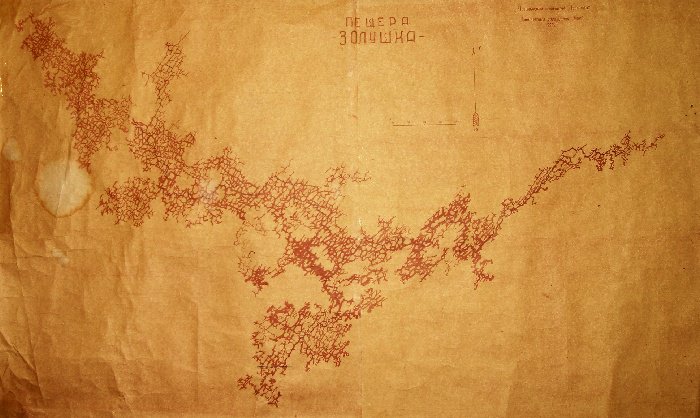
Over the next 15 years, thanks to the collaboration between Ukrainian and Moldovan speleologists, over 95% of the karst system was mapped, with the total length of the galleries reaching 90 km.
In 1999, a tragedy occurred in the cave resulting in the death of two people, which led to the cave being completely closed to visitors. At that time, two tourists entered the cave and passed away just a few meters from the entrance due to carbon dioxide poisoning. The cave remained closed for 5 years but was later reopened following an expedition organized by the ABIS speleo-club and the quarry owner, which proved the cave was in a favorable condition for visiting. During that period, the ABIS club evacuated two trucks of waste resulting from spontaneous tourism in the cave, which had been open until 1999. Since 2005, the entrance to the cave has been locked; excursions are rare and managed by the ABIS speleo-club, and work in the cave is carried out only for mapping, searching for gallery extensions, measuring water levels in lakes, and photo/video capture.
After 2005, Moldovan speleologists, in collaboration with Ukrainian ones, again put forth an enormous effort to re-map the cave using more modern mapping methods and developed a digital map of the cave. The latest accumulated data shows that the total length of the cave does not differ drastically from the data obtained during the first mapping: a total of 92 km in plan and 87 km taking the relief into account, a surface area of 206,500 $m^2$, and a volume of 550,000 $m^3$. The greatest discoveries took place until the 1990s. We can only imagine the enthusiasm of the pioneers who, after traversing the narrow galleries at the cave entrance, entered the enormous halls with heights of 9 m for the first time, discovered over 60 underground lakes with crystal-clear water, and came across unique speleothems such as fragile clay stalagmites originating from biological processes, gypsum needles – anthodites up to 15 cm long, differently colored clay, fine films of iron and oxidized manganese on the walls and ceilings of the galleries, and gypsum monocrystals. Every year, the cave increases its length by several dozen or hundreds of meters as speleologists explore new galleries.