
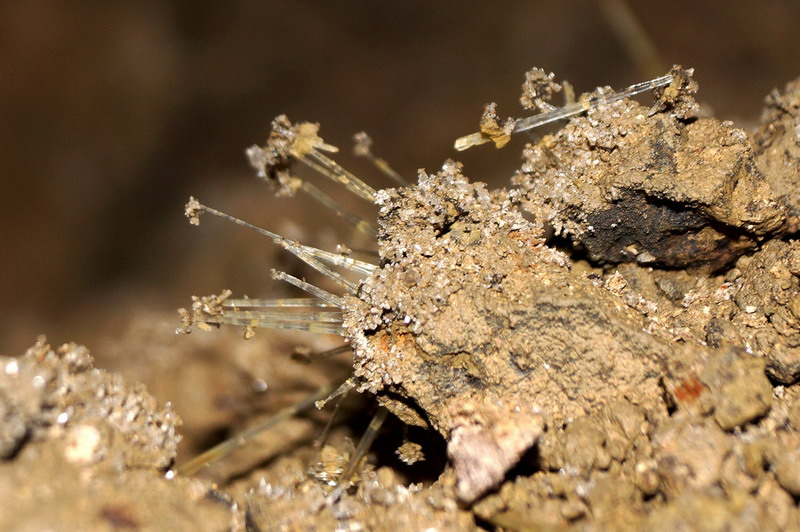
Gypsum needles (sometimes called filamentous crystals or selenite needles) are fragile formations found in sulfate and carbonate caves. Unlike common stalactites, their growth is not governed by gravity, but by the laws of capillary pressure.
Growth Mechanism
The main feature of gypsum needles is that they grow from the base rather than the tip. The nutrient solution enters through microscopic pores in the walls or loose cave sediments.
- Capillary Effect: Research shows that enormous pressure is required to push a crystal out of a pore. Since external pressure in caves is insufficient, the primary driver of growth is capillary pressure combined with seasonal humidity cycles.
- Evaporation: The solution rises through internal channels or the pores of the substrate and crystallizes at the exit, gradually “extruding” the needle outward.
Morphology and Appearance
- Shape: Short needles are usually perfectly straight and have a uniform cross-section (from 0.002 to 0.1 mm in diameter). Longer specimens may bend under their own weight or due to air currents.
- Dimensions: The length of the needles varies from a few millimeters to half a meter or more.
- Aggregates: Needles often form complex clusters that speleologists call “anthodites,” “beards,” or cave “cobwebs.” If needles grow from a single point in different directions, they form “hedgehogs.”
Formation Conditions
For needles to appear, a porous substrate (such as limestone or clay) and a specific microclimate are required. A buffer substrate plays a vital role: it accumulates moisture during the rainy season and gradually releases it through micropores during the dry period, ensuring slow and stable crystal growth. In some cases, sulfate-reducing bacteria are involved in the process, influencing the chemical composition of the solution.
Gypsum needles are so delicate that they can begin to grow or disintegrate even from a minor change in humidity caused by a human’s presence in the cave.
